EN|DE

Author: Desalination Institute DME

  • Designing plants that keep running

    Designing plants that keep running

    A technical piece on resilient system design: coupling with renewables, distributed capacity and part-load capability - the questions that belong on the drawing board, not in the crisis meeting.

    Source: Jacobs

    A short note. Our assessment is in the lead article of this issue.

  • How an attack disrupts a water supply

    How an attack disrupts a water supply

    Al Jazeera sets out how strikes on desalination plants translate into a supply problem: the plant itself is rarely the weak point, the power feed and the intake are.

    Source: Al Jazeera

    A short note. Our assessment is in the lead article of this issue.

  • Could the Gulf's water really be cut off?

    Could the Gulf's water really be cut off?

    A CSIS analysis counts through the question soberly: which plants, which capacities, which reserves - and where the assumption of a quick collapse does not hold.

    Source: CSIS

    A short note. Our assessment is in the lead article of this issue.

  • When a desalination plant burns, it is no longer just an asset

    When a desalination plant burns, it is no longer just an asset

    Between March and August 2026, desalination plants in Kuwait and Bahrain were damaged in attacks. Not once, and not in one place. That changes what a desalination plant is: it is no longer only an industrial asset, it is part of a country's civil defence.

    One of the attacks cost the life of a worker. We write about the technology here because that is our contribution, not because it is the more important part.

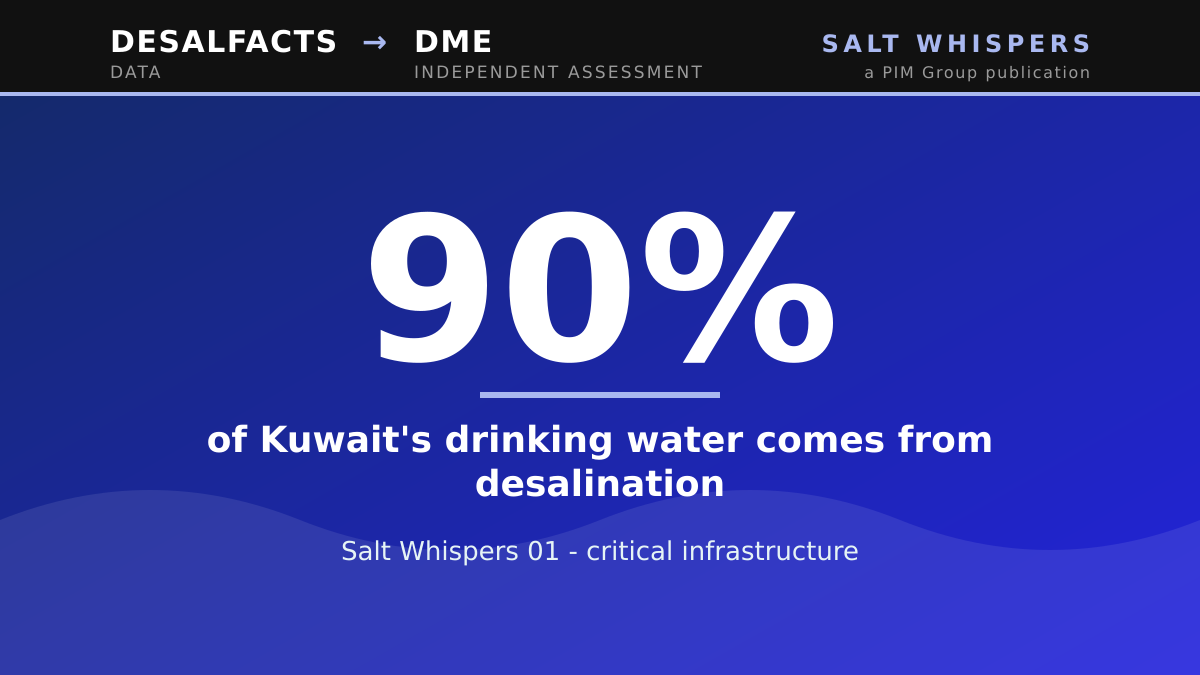
    The numbers explain why this hurts. Around 90 per cent of Kuwait's drinking water comes from desalination, produced by eight major coastal plants with a combined capacity of more than 2.2 million cubic metres per day. There is no aquifer to fall back on. A plant that stands still is not a production loss, it is a supply crisis with a clock running.

    What we take from it. Most plants in the Gulf were designed for reliability, not for hostility. Those are different disciplines. Reliability asks what fails on its own; resilience asks what happens when something is made to fail, and how fast the rest carries on. In our experience three questions separate the two, and they are rarely on the drawing board:

    • How long does the country hold without you? Storage in days, not in cubic metres. Anything under 48 hours is a political problem, not a technical one.
    • What is the one thing that stops everything? Usually the power feed, the intake, or a single high-voltage building. Redundancy that shares a room is not redundancy.
    • How fast can you run at part load? Forty per cent output tomorrow beats one hundred per cent in three months.

    None of this is exotic engineering. It is design intent, decided early, and it costs a fraction at the design stage of what it costs after an event. We say this as an institute that builds no plants and sells no equipment: the assessment is the product, and it is the same assessment we would want for our own asset.

    Sources for the notes below are linked directly to the publishing outlet. Figures on Kuwait's supply structure as reported by the outlets cited.

  • Strike damages a Kuwait desalination plant

    Strike damages a Kuwait desalination plant

    An Iranian strike damaged a Kuwaiti power and desalination plant, and further attacks hit facilities in Bahrain. Kuwait draws the overwhelming share of its drinking water from desalination.

    Source: AP News

    A short note. Our assessment is in the lead article of this issue.

  • Turkmenistan tenders an audit of its desalination plants

    Turkmenistan tenders an audit of its desalination plants

    A tender has been announced for the audit of existing seawater desalination plants in the Balkan velayat, Turkmenistan. Independent audits of installed capacity are exactly the kind of mandate that decides whether an asset keeps its value.

    Source: Turkmenportal

    A short note. Our assessment of what this means follows in the monthly issue.

  • A new name, a new rhythm

    A new name, a new rhythm

    A new name, a new rhythm. What you knew as DESALFACTS NEWS now continues as Salt Whispers - once a month instead of once a week.

    The reason is simple: a month gives us the distance to separate what matters from what merely happened. You still get the industry, filtered through an institute that sells no plants. Same source, same independence, more thought per line.

    What stays

    • The source: our own DESALFACTS database - tens of thousands of categorised industry news items, plants, technologies and patents.
    • The independence: we sell no plants, so we can say plainly what we think.
    • The selection: made by people who assess desalination assets for a living.

    What changes

    • Monthly instead of weekly - one issue with the bigger picture rather than a weekly list.
    • Short notes in between - when something cannot wait, it appears on our newsletter page.
    • An assessment, not a summary - each issue follows one topic and tells you what we make of it.

    Nothing changes for your subscription. If this is not what you want, the unsubscribe link is where it always was.

  • Short notes between the issues

    Short notes between the issues

    From now on you will find short notes here between two issues: a technology that suddenly matters, a tender that says more than the press release, a number worth a second look. Everything longer goes into the monthly issue.

    The rule stays the same as for the newsletter: we sell no plants, so we can say plainly what we think.

Part of the PIM Group · independent since 2002 · a hidden champion in water, energy and resources.

Salzgeflüster - our monthly desalination newsletter. Independent, no advertising. Subscribe free.