Between March and August 2026, desalination plants in Kuwait and Bahrain were damaged in attacks. Not once, and not in one place. That changes what a desalination plant is: it is no longer only an industrial asset, it is part of a country's civil defence.
One of the attacks cost the life of a worker. We write about the technology here because that is our contribution, not because it is the more important part.
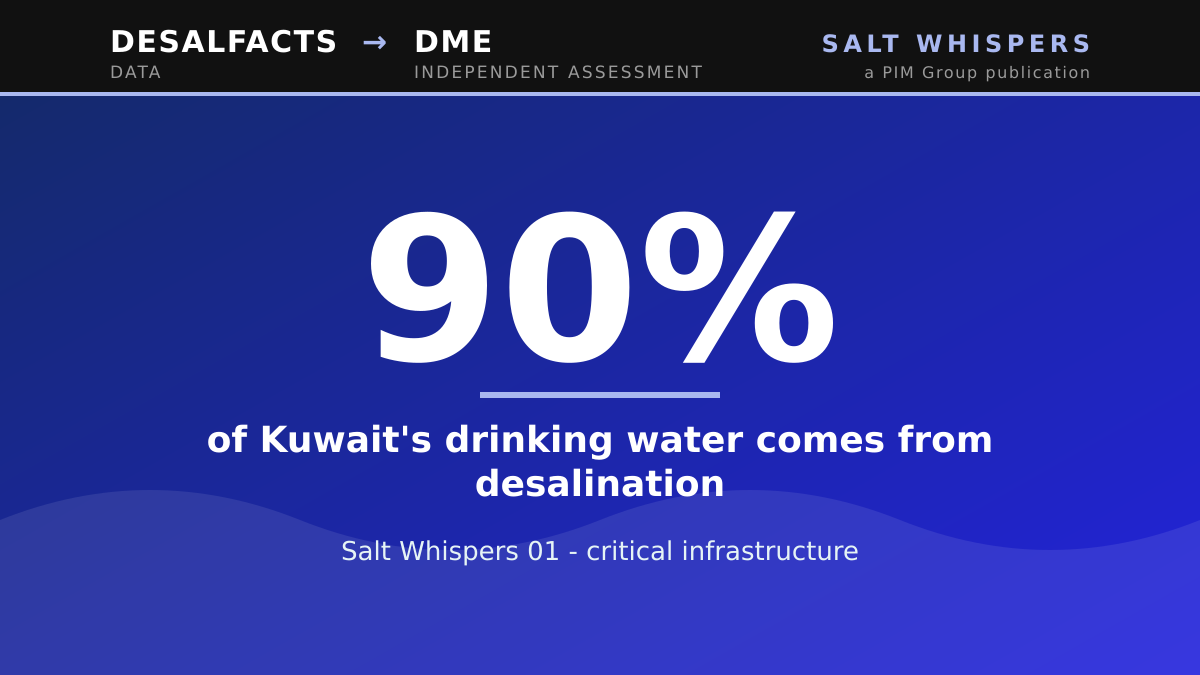
The numbers explain why this hurts. Around 90 per cent of Kuwait's drinking water comes from desalination, produced by eight major coastal plants with a combined capacity of more than 2.2 million cubic metres per day. There is no aquifer to fall back on. A plant that stands still is not a production loss, it is a supply crisis with a clock running.
What we take from it. Most plants in the Gulf were designed for reliability, not for hostility. Those are different disciplines. Reliability asks what fails on its own; resilience asks what happens when something is made to fail, and how fast the rest carries on. In our experience three questions separate the two, and they are rarely on the drawing board:
- How long does the country hold without you? Storage in days, not in cubic metres. Anything under 48 hours is a political problem, not a technical one.
- What is the one thing that stops everything? Usually the power feed, the intake, or a single high-voltage building. Redundancy that shares a room is not redundancy.
- How fast can you run at part load? Forty per cent output tomorrow beats one hundred per cent in three months.
None of this is exotic engineering. It is design intent, decided early, and it costs a fraction at the design stage of what it costs after an event. We say this as an institute that builds no plants and sells no equipment: the assessment is the product, and it is the same assessment we would want for our own asset.
Sources for the notes below are linked directly to the publishing outlet. Figures on Kuwait's supply structure as reported by the outlets cited.